|
First Presbyterian Theater presents
"Agnes of God"
By John Pielmyer
Starring Kate Black, Jennifer Poiry, & Lois Watkins
Directed by Thom Hofrichter
CAST BIOGRAPHIES
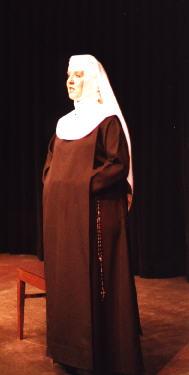
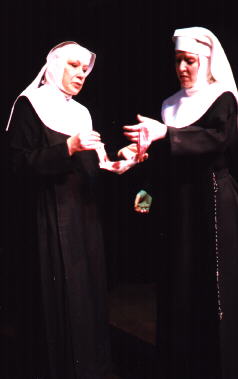
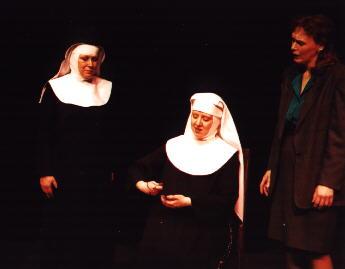
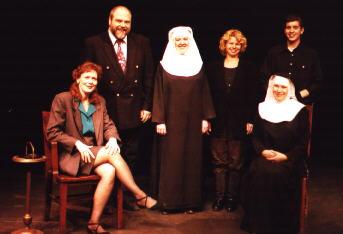
(Cast photos below)
Kate Black (Dr. Livingstone) began her stage career at FPT in 1971 appearing as a poetry reader in Michael Colgrass's The Earth's a Baked Apple. Her most recent performance was in last season's Three Tall Women as the aged "A." in between, Kate has appeared at The Magic Theatre and S. F. Rep in San Francisco, as well as at the Civic, PIT, Arena, and FPT. Kate teaches water fitness at the YWCA, is a freelance commercial actor, and the mother of two busy boys.
Jennifer Poiry (Sister Agnes) is thrilled to be making her FPT debut. She studies voice at IPFW, cantors at St. Vincent, publishes The Green Room theatrical magazine, and plans wedding dates with her fiance Scott Nedberg. Jen thanks Thom, Kate, Lois, Cathy, and Randy for the thrilling experience of Agnes of God.
Lois Watkins (Mother Miriam Ruth) studied ballet at the School of American Ballet and jazz at Dance Circle (New York), and studied acting at the Royal Academy of Dramatic Arts in London. As a performer she has been a soloist with regional ballet companies, acted for over forty-five years in productions spanning Chekhov to Simon, and has been featured in industrial films, television commercials, and voice-overs for regional media as well as international markets. Lois is an attorney and a Registered Nurse.
PRODUCTION STAFF BIOS
Thom Hofrichter (director/designer) celebrated his two-year anniversary as Minister of Drama at FPT on January 1. He is proud of the work that has been produced here in that time and appreciates the countless volunteers who make it possible to create meaningful work in this wonderful theater space.
Cathy Christoff (stage manager) is making her behind-the-scenes debut. As an actor, she was last seen in FPT's Ruddigore. Other credits include Guys and Dolls, Life with Father, and Dancing Gershwin at Civic; and Nightwatch and Of Thee I Sing at Arena. Cathy is an attorney at Christoff & Christoff Attorneys and mother to Julia, Christoff, and Kate.
Randy Oswalt (assistant stage manager) is a student at Harding High School. He has appeared as an actor in FPT's Our Town and Rip Van Winkle, as well as at his high school in The Dining Room. In March Randy will be joining a cast of 30+ in FPT's Jesus Christ Superstar. Agnes of God marks his first experience as an assistant stage manager.
Links to sites about "Agnes of God"
|
|
Click a thumbnail below for a larger photo |
|

9 kb JPG |

10 kb JPG |

10 kb JPG |

15 kb JPG
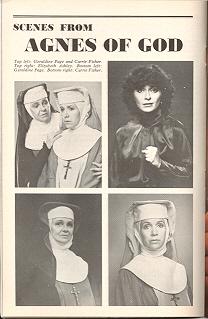 Photos from a Broadway playbill
|
Looking for God; Local theater's play raises tough questions
By Steve Penhollow The Journal Gazette
It has been a long time since anyone parted a sea. Miracles come in more modest
guises these days, if they come at all. But if something truly divine did arrive
on our doorstep, would we have the eyes to see it?
That's one of the many open-ended questions posed by John Pielmeier's play
"Agnes of God," which starts Thursday at First Presbyterian Theatre.
The play is about a dead infant found at a convent, an atheistic psychiatrist
assigned by the court to get to the motivational bottom of things, a Mother
Superior with a cache of secrets, and a young, seemingly guileless nun named
Agnes, who is the probable mother and murderer of the child but is also quite
possibly a messenger of God.
Fort Wayne actress Jennifer Poiry portrays Agnes. The demanding role requires
her to sing in such an angelic way that she makes instant converts to strong
religious faith.
Agnes exhibits other challenging quirks: she lies when she seems to be telling
the truth and tells the truth when she seems to be lying. Sometimes she lies on
purpose, sometimes she gives false accounts because she has buried the true turn
of events. Sometimes she reveals alternate personalities, and sometimes she
reveals information that she should not logically know.
The 28-year-old Poiry started acting as a Leo High School student, but gave it
up to concentrate on an education degree at Indiana-Purdue, Fort Wayne. Now, she
is actively auditioning again, exercising her voice in pursuit of a music degree
at IPFW, and she publishes a bimonthly magazine focused on the northeast Indiana
theater scene called The Green Room.
Poiry says the toughest thing about playing Agnes is creating a balanced
portrayal: The character has a beatific exterior that must somehow remain
largely intact as her more earthly inner complexities are revealed.
"Thom (Hofrichter, the director) is always asking me, "What is the
subtext?' Every line has a subtext. I must always be asking myself, `What is
Agnes really thinking here?' `Does Agnes realize the implications of what she is
saying?' "
Poiry, a long-time cantor at St. Vincent Catholic Church, may have a slightly
easier time with the musical elements of the play.
She won't go so far as to claim she produces the music of the angels, but she
says people have credited her voice with greatly enriching church services.
"I have been told my voice is very pure," she says. "I'm not sure
what that means, but I think it's a compliment."
Hofrichter says the enigma that is Agnes parallels the enigma that is
"Agnes of God."
The play ends ambiguously, leaving the audience with more questions than were
initially posed. Hofrichter says he tried to preserve this neutral quality.
"Is she touched by God? Is she crazy?," Hofrichter rhetorically asks.
"The doctor and Mother Superior both make some convincing arguments. I just
get out of the way. It is up to each audience member to decide for him or
herself."
The play is less about Agnes than it is about the two elder women, who both
think they have Agnes' best interests at heart. The two women are really
stand-ins for different types of audience members: the psychiatrist is someone
who made science her god after the death of a sister but who secretly longs for
a renewed sense of awe, the oncemarried Mother Superior is someone whose fragile
faith hinges on sheltering Agnes at all costs.
They make formidable intellectual adversaries, and their breakneck arguments
crackle with ideas. Pielmeier's notes specify that lines must overlap;
Hofrichter says Pielmeier wanted to build tension.
"The trick is to have both actors talk over each other without losing
either line," Hofrichter says. "If it's done right, it should have an
almost musical rhythm."
Hofrichter believes the fractured state the characters find themselves in at the
end of the play, and the reluctance of the playwright to land on one side or the
other, makes the play spiritually honest.
"We all experience chaos now and then, but it usually makes us better
people," Hofrichter says. "If you aren't lost and confused sometimes,
how strong can your spirituality be?
"I am suspicious of people who say they have definitively found God, that
they know all the answers. Being devout is about never giving up the search for
God."
Show at a glance
What: "Agnes of God"
When: 8 p.m. Thursday, Friday, Saturday, Jan. 15, 16, 22, 23; 2 p.m. Jan. 17.
Where: First Presbyterian Theatre, 300 W. Wayne St.
Admission: $5 for Thursday performance. All other performances: $12 adults, $10
students and ages 60 and older. For more information, call 422-6329.
PUBLISHED SUNDAY JANUARY 3, 1999


Click to subscribe to greenroom
Sign My Guestbook  View My Guestbook